
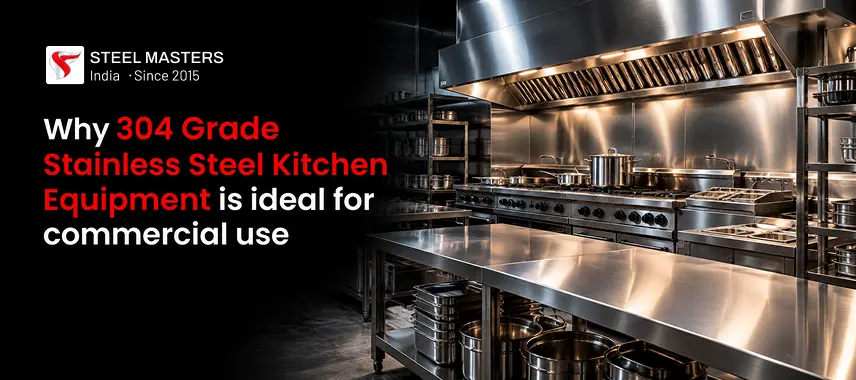
A commercial kitchen is one of the busiest working environments in the food-service industry. Restaurants, hotels, cloud kitchens, catering businesses, hospitals, bakeries, and institutional kitchens all require equipment that can withstand continuous use while maintaining hygiene, functionality, and durability.
Among the different materials available for professional kitchens, stainless steel has become a widely preferred option. In particular, 304 Grade Stainless Steel Kitchen Equipment is commonly selected for applications where corrosion resistance, cleanliness, strength, and ease of maintenance are important.
From preparation tables and sinks to storage cabinets and custom workstations, 304 stainless steel can provide a practical foundation for demanding commercial kitchen operations. But what makes this grade suitable for professional use? Let's explore its key advantages and applications.
What Is 304 Grade Stainless Steel?
304 stainless steel is an austenitic stainless steel grade containing chromium and nickel. Its composition gives it a useful combination of corrosion resistance, durability, formability, and surface finish.
In commercial kitchens, equipment is regularly exposed to water, steam, food ingredients, cleaning agents, heat, and constant handling. Materials used in these environments need to perform reliably under these conditions.
304 stainless steel is therefore commonly used for food-service equipment and fabrication applications where a durable and easy-to-clean surface is required.
The material can also be fabricated into different shapes and configurations, allowing manufacturers to create equipment according to the layout and operational requirements of a commercial kitchen.
1. Strong Resistance to Corrosion
Commercial kitchens deal with moisture every day. Sinks, preparation areas, washing stations, and cooking zones can be exposed to water and steam for long periods.
One of the important benefits of 304 stainless steel is its resistance to corrosion in many everyday kitchen environments. The chromium in stainless steel helps form a protective oxide layer on the surface, helping the material resist rust and oxidation.
This makes it suitable for equipment that regularly comes into contact with moisture.
While no material is completely maintenance-free, appropriate cleaning and care can help stainless steel equipment retain its performance and appearance for many years.
2. Excellent Hygiene for Food Preparation
Hygiene is a fundamental requirement in any professional food-service environment. Preparation surfaces need to be easy to clean and maintain because they come into frequent contact with ingredients and food products.
The smooth, non-porous surface of stainless steel makes it practical for food preparation areas. It does not readily absorb liquids or food particles, allowing surfaces to be cleaned efficiently.
This is one reason Commercial Stainless Steel Kitchen Equipment is widely used for preparation counters, work tables, sinks, storage areas, and other applications where cleanliness is important.
Regular cleaning and appropriate sanitation procedures are still essential, but the material itself provides a practical surface for maintaining a hygienic workspace.
3. Built for Demanding Commercial Operations
Commercial kitchens are very different from residential kitchens. Equipment may be used continuously throughout the day, with employees preparing large quantities of food and moving heavy utensils, containers, and ingredients.
Kitchen equipment therefore needs to handle repeated use.
304 stainless steel provides a strong material for many commercial applications. When equipment is properly designed, fabricated, welded, and installed, it can withstand the demands of daily kitchen operations.
This makes it suitable for busy restaurants, hotels, catering facilities, cloud kitchens, and institutional food-service environments.
4. Easy to Clean and Maintain
Cleaning is part of everyday commercial kitchen operations. Work surfaces, sinks, counters, shelves, and equipment need to be cleaned frequently to maintain an organized working environment.
Stainless steel is relatively easy to clean when it has an appropriate surface finish and is maintained correctly.
Simple routine cleaning can help remove food residue, grease, and everyday dirt. Avoiding harsh cleaning methods that can damage the surface is also important.
The combination of durability and straightforward maintenance makes 304 stainless steel a practical material for professional kitchen equipment.
5. Suitable for Custom Kitchen Fabrication
Every commercial kitchen has different requirements. A small restaurant may need a compact preparation area, while a large hotel kitchen may require multiple workstations, storage systems, washing areas, and service counters.
This is where custom fabrication becomes important.
304 Stainless Steel Kitchen Equipment can be fabricated into different sizes and configurations depending on the available space and workflow requirements.
For example, a commercial kitchen may require:
- Custom stainless steel work tables
- Preparation counters
- Wall-mounted shelves
- Storage cabinets
- Equipment stands
- Commercial sinks
- Dishwashing tables
- Stainless steel racks
- Service counters
- Custom workstations
Custom fabrication allows businesses to use their available kitchen space more efficiently.
6. Supports Better Kitchen Organization
A well-organized kitchen can make daily operations more efficient. Employees should be able to access ingredients, utensils, equipment, and work surfaces without unnecessary movement.
Poorly arranged equipment can create congestion and slow down kitchen operations.
Stainless steel equipment can be designed around different workflow zones, including:
Receiving and storage:
Areas for storing ingredients and supplies.
Preparation:
Work tables and counters for cutting, mixing, portioning, and other preparation tasks.
Cooking:
Spaces for cooking equipment and supporting workstations.
Washing:
Sinks, dishwashing tables, and cleaning areas.
Service:
Counters and equipment used for plating, dispatch, or food service.
Planning these zones carefully can help create a more structured commercial kitchen.
7. Professional and Modern Appearance
Functionality is the main priority in a commercial kitchen, but appearance also matters. Stainless steel gives professional kitchens a clean and modern appearance.
Its reflective surface and consistent finish can create a visually organized environment when equipment is properly maintained.
For businesses that operate open kitchens or visible food-preparation areas, maintaining clean and professional-looking equipment can also contribute to the overall customer experience.
8. Versatile Applications Across Food-Service Businesses
The benefits of 304 stainless steel are not limited to restaurants.
Different types of commercial food-service operations can use stainless steel equipment, including:
Restaurants
Restaurants require preparation tables, sinks, storage equipment, shelving, counters, and other supporting infrastructure.
Hotels
Hotel kitchens often handle large-scale food preparation and require equipment designed for continuous operation and high-volume service.
Cloud Kitchens
Cloud kitchens need efficient layouts because available space is often limited. Custom stainless steel equipment can help maximize usable workspace.
Catering Businesses
Catering operations require durable preparation and storage equipment that can support large quantities of food.
Hospitals and Institutions
Institutional kitchens need organized preparation, storage, washing, and service areas designed around their operational requirements.
Bakeries and Food Production Units
Food production environments can benefit from stainless steel work surfaces, racks, counters, and custom fabrication.
9. Long-Term Value for Commercial Kitchens
When purchasing kitchen equipment, businesses should consider more than the initial cost. Durability, maintenance, usability, and expected service life are also important factors.
Well-designed stainless steel equipment can provide long-term value because it is durable, reusable, and suitable for demanding environments.
Choosing quality equipment can also help reduce the frequency of replacements caused by premature wear or unsuitable materials.
However, the actual lifespan of equipment depends on several factors, including material quality, fabrication standards, usage conditions, cleaning practices, and maintenance.
10. Why Choosing the Right Manufacturer Matters
The quality of stainless steel equipment depends not only on the grade of steel but also on how the equipment is designed and fabricated.
A professional Stainless Steel Kitchen Equipment Manufacturer should consider factors such as:
- Kitchen dimensions
- Workflow requirements
- Equipment placement
- Storage needs
- Workstation height
- Cleaning access
- Material thickness
- Welding quality
- Surface finishing
- Installation requirements
Proper design can help ensure that equipment fits the kitchen and supports the way staff actually work.
A manufacturer with commercial kitchen fabrication experience can also help businesses develop solutions for specific operational requirements rather than relying only on standard equipment sizes.
11. 304 Stainless Steel vs. Other Materials
Commercial kitchens can use a variety of materials for different applications. However, stainless steel offers a useful combination of durability, hygiene, appearance, and maintenance.
Wood, for example, may not be suitable for every commercial food-preparation application because it can absorb moisture and requires specific maintenance.
Some coated or painted surfaces may also experience wear or damage over time, particularly in demanding environments.
304 stainless steel provides a durable metal surface that can be used across many kitchen applications. The appropriate material should nevertheless be selected according to the specific equipment, environment, and operating conditions.
12. Maintenance Tips for 304 Stainless Steel Equipment
Even high-quality stainless steel equipment requires proper maintenance.
Businesses can help preserve their equipment by following simple practices:
- Clean surfaces regularly.
- Remove food residue promptly.
- Use suitable stainless steel cleaning products.
- Avoid abrasive cleaning materials that may scratch the surface.
- Keep equipment dry when practical.
- Clean spills quickly.
- Follow the manufacturer's maintenance recommendations.
- Inspect welded joints and moving components periodically.
Good maintenance not only supports appearance but can also contribute to the equipment's long-term performance.
How 304 Stainless Steel Improves Commercial Kitchen Planning
Material selection should be considered alongside the overall kitchen design.
A commercial kitchen should be planned around the movement of ingredients, employees, utensils, equipment, and finished food. Stainless steel equipment can be customized to fit these workflow requirements.
For example, a preparation table can be positioned close to storage, while washing equipment can be located near the cleaning area. Shelving can be installed to keep frequently used items accessible without occupying valuable floor space.
This approach allows businesses to create a kitchen that is not only durable but also organized around daily operations.
Why Businesses Choose 304 Grade Stainless Steel Kitchen Equipment
The popularity of 304 Grade Stainless Steel Kitchen Equipment comes from its combination of practical characteristics.
It offers:
- Good corrosion resistance
- Durable construction
- Easy-to-clean surfaces
- Professional appearance
- Versatile fabrication possibilities
- Suitability for food-service environments
- Compatibility with custom kitchen layouts
These qualities make it a practical option for many commercial kitchen applications.
Final words
A commercial kitchen requires equipment that can handle demanding daily operations while supporting hygiene, organization, and productivity. 304 Grade Stainless Steel Kitchen Equipment provides a combination of durability, corrosion resistance, cleanability, and versatility that makes it suitable for many professional food-service environments.
From restaurants and hotels to cloud kitchens, catering facilities, and institutional kitchens, stainless steel can be incorporated into preparation areas, storage systems, sinks, workstations, counters, and custom fabrication.
The best results come from combining the right material with thoughtful kitchen design, quality fabrication, proper installation, and regular maintenance. For businesses planning a new commercial kitchen or upgrading an existing facility, choosing appropriately designed stainless steel equipment can be an important step toward creating a durable and efficient working environment.
Table of Contents
- What Is 304 Grade Stainless Steel?
- 1. Strong Resistance to Corrosion
- 2. Excellent Hygiene for Food Preparation
- 3. Built for Demanding Commercial Operations
- 4. Easy to Clean and Maintain
- 5. Suitable for Custom Kitchen Fabrication
- 6. Supports Better Kitchen Organization
- 7. Professional and Modern Appearance
- 8. Versatile Applications Across Food-Service Businesses
- Restaurants
- Hotels
- Cloud Kitchens
- Catering Businesses
- Hospitals and Institutions
- Bakeries and Food Production Units
- 9. Long-Term Value for Commercial Kitchens
- 10. Why Choosing the Right Manufacturer Matters
- 11. 304 Stainless Steel vs. Other Materials
- 12. Maintenance Tips for 304 Stainless Steel Equipment
- How 304 Stainless Steel Improves Commercial Kitchen Planning
- Why Businesses Choose 304 Grade Stainless Steel Kitchen Equipment
- Final words