
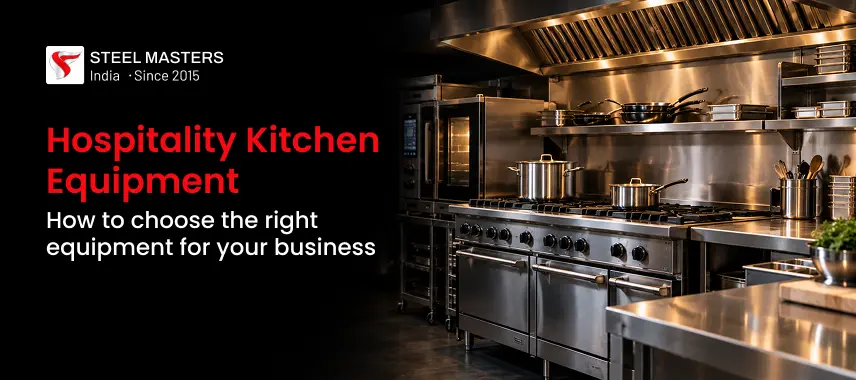
Short answer: The right hospitality kitchen equipment fits your menu, your daily order volume, your floor space, your fuel and power supply, and your budget. Buy for the busiest day you expect, not for a showroom display. Then compare build quality, running cost, cleaning time and after-sales service before you look at price.
A kitchen is the part of a hotel, restaurant, café or catering unit that earns money every hour. A poor equipment choice slows every order, raises your gas and power bills, and costs you staff time. This guide walks through the decisions in the order that saves the most money.
What Is Hospitality Kitchen Equipment?
Hospitality kitchen equipment means the commercial kitchen equipment used to receive, store, prepare, cook, hold, serve and clean up food in hotels, restaurants, cafés, cloud kitchens, canteens and banquet halls. It covers cooking ranges, ovens, fryers, refrigeration, prep tables, dishwashing units, exhaust hoods and storage racks. Large canteens and central kitchens also use industrial kitchen equipment such as bulk cookers and tilting pans.
Commercial models differ from home models in three ways: heavier materials, higher output, and parts built to run for many hours every day.
Step 1: Match Hospitality Kitchen Equipment to Your Menu and Daily Covers
Your menu decides your equipment list. Restaurant kitchen equipment for a North Indian menu means tandoors, heavy burners and gravy tanks. A café needs an espresso machine, a griddle and a display chiller. A bakery needs ovens and proofers.
Write down your ten best-selling dishes and list every cooking step for each. Then estimate the covers (meals served) on a peak day. A 40-seat restaurant that turns its tables twice serves around 80 covers, and the equipment must handle the dinner rush, not the daily average.
Ask yourself:
- Which dishes need the most burner or oven time?
- Which steps happen at the same time during peak hours?
- Will the menu change in the next two years?
If the menu may change, pick flexible items such as modular ranges and combi ovens over single-purpose machines.
Step 2: Measure Your Space and Plan the Workflow
Measure the room before you shop. Note the length, width, ceiling height, door width, and the position of drains, gas lines, power points and exhaust ducts. A machine that cannot pass through your door is an expensive mistake.
Plan the layout in the order food moves: receiving, cold and dry storage, preparation, cooking, plating, service and dishwashing. Keep raw and cooked food paths apart. Leave an aisle of about a metre where staff cross paths, and place the cooking line close to the pass. A short, clean path saves thousands of steps over a year.
Ask your supplier for a layout drawing before you place the order.
Step 3: Check Fuel, Power and Water
Check what your building can supply before you pick any machine.
- Gas: Decide between LPG cylinders, piped natural gas or electric. Gas ranges heat fast and suit wok and tandoor-style cooking. Electric units give steady heat and are simple to clean.
- Power: Many commercial machines need a three-phase supply. Confirm your sanctioned load and how stable your voltage is. If your area has frequent dips, fit a stabiliser and keep a backup supply for refrigeration.
- Heat: Summer temperatures cross 40°C in many north Indian cities. Choose refrigeration with compressors rated for high room temperature, and keep space behind each unit for airflow.
- Water: Hard water leaves scale inside dishwashers, steamers and coffee machines. A softener or filter protects them and cuts repair calls.
- Ventilation: A busy cooking line needs a hood and exhaust fan sized to match it. Poor ventilation raises room temperature and slows your staff.
Stainless Steel Kitchen Equipment: Pick the Right Material and Build
Stainless steel kitchen equipment is the standard in commercial kitchens because it resists rust, wipes clean and handles heat. Grade 304 suits food-contact surfaces and cold areas. Grade 202 costs less but marks and rusts faster in humid kitchens, so use it only for dry, low-contact items if the budget is tight.
Also check steel thickness, welded joints, adjustable feet and door seals. Ask for the steel grade in writing on the quote.
Core Commercial Kitchen Equipment by Section
| Section | Common equipment | What to check |
| Cooking | Gas range, tandoor, griddle, fryer, combi oven | Burner output, thermostat accuracy, ease of cleaning |
| Cold storage | Under-counter fridge, upright freezer, walk-in cold room, display chiller | Temperature range, compressor brand, door seals, power use |
| Preparation | Work tables, sinks, vegetable cutter, dough mixer | Table height, motor power, safety guards |
| Cleaning | Dishwasher, pot-wash sink, grease trap | Cycle time, water use, drain connection |
| Holding and service | Bain-marie, hot cupboard, racks, trolleys | Capacity, material, ease of movement |
| Air and safety | Hood, exhaust, fire extinguishers, gas shut-off | Size to match cooking line, filter access |
New or Used Equipment?
New equipment comes with a warranty and better energy ratings. Used equipment costs less upfront but carries the risk of hidden wear.
Buy used only for simple, sturdy items such as steel tables, racks and sinks. Buy new for refrigeration, fryers, ovens and anything with electronics. If you do buy used, ask to see it running and get a written bill that lists the serial number.
Hospitality Kitchen Equipment Budget and Total Cost of Ownership
The price on the tag is only part of the cost. Add up five items: purchase price, delivery and installation, monthly energy and water use, repairs and spare parts, and the years the machine will last. A cheaper fryer that uses more gas and breaks twice a year can cost more over three years than a better one.
Split your budget by importance. Spend more on the items that touch every order, such as the cooking line and refrigeration, and less on items you use rarely. Keep a margin of about ten percent for installation and items you forgot. If you use a lease or instalment plan, compare the total amount repaid, not only the monthly payment.
Why Equipment Choices Matter to Owners and Investors
Equipment is one of the largest costs in a new hotel, restaurant or cloud kitchen. Lenders and partners often ask for an itemised equipment list with brand, model, price and warranty, because it shows the plan is realistic. Dependable hospitality kitchen equipment with local service keeps your kitchen open, and an open kitchen protects your income. Good records of purchase, servicing and warranty also help if you sell the business or add outlets later.
Hotel Kitchen Equipment, Café Lines and Cloud Kitchens
The market is wide. Hotel kitchen equipment needs banquet-scale capacity, cafés need compact lines, and cloud kitchens need small, fast setups built around delivery orders. Know which type you are before you ask for quotes.
Safety, Hygiene and Licences
In India, every food business needs an FSSAI licence or registration, and your kitchen should meet the hygiene conditions that come with it. Larger premises may also need fire safety approval from the local authority.
Pick equipment with smooth surfaces, rounded corners and parts that come off for cleaning. Check that gas lines have shut-off valves, that machines are earthed, and that staff know the cleaning schedule. Confirm current rules with your local authority before you open.
How to Choose a Commercial Kitchen Equipment Manufacturer or Supplier
Hospitality kitchen equipment is only as good as the service behind it. Before you sign, ask:
- Do they have service engineers in your city, and how fast do they respond?
- Are spare parts stocked locally?
- What does the warranty cover, and for how long?
- Can they show you kitchens they have installed?
- Do they handle layout, delivery and installation under one contract?
- Is the quote itemised with brand, model and steel grade?
Collect at least three quotes, including one from a commercial kitchen equipment manufacturer that sells direct, and compare them line by line.
Common Mistakes to Avoid
- Buying before measuring the room and the doorway
- Sizing equipment for an average day instead of a peak day
- Ignoring gas, power and water costs
- Skipping the check on local service and spare parts
- Copying another restaurant’s list when your menu is different
Quick Buying Checklist for Restaurant Kitchen Equipment
- Menu and peak-day covers written down
- Room measured and layout drawn
- Fuel, power and water confirmed
- Steel grade and build quality checked
- Running cost estimated for each major item
- Warranty and service terms confirmed in writing
- Licences and safety rules checked
- Three itemised quotes compared
Final Words
Choosing hospitality kitchen equipment comes down to a few clear steps: write down your menu and peak-day covers, measure the room, confirm fuel, power and water, check steel grade and build, count the full cost over several years, and pick a supplier who will service what they sell. Follow these steps and your kitchen will run faster, cost less to operate and stay open on your busiest days.
Setting up or upgrading a kitchen? Share your menu, seating and space with our team, and we will suggest a layout and an itemised equipment list. Call 9915404412 or email support@steelmastersindia.com for a quote.
Table of Contents
- What Is Hospitality Kitchen Equipment?
- Step 1: Match Hospitality Kitchen Equipment to Your Menu and Daily Covers
- Step 2: Measure Your Space and Plan the Workflow
- Step 3: Check Fuel, Power and Water
- Stainless Steel Kitchen Equipment: Pick the Right Material and Build
- Core Commercial Kitchen Equipment by Section
- New or Used Equipment?
- Hospitality Kitchen Equipment Budget and Total Cost of Ownership
- Why Equipment Choices Matter to Owners and Investors
- Hotel Kitchen Equipment, Café Lines and Cloud Kitchens
- Safety, Hygiene and Licences
- How to Choose a Commercial Kitchen Equipment Manufacturer or Supplier
- Common Mistakes to Avoid
- Quick Buying Checklist for Restaurant Kitchen Equipment
- Final Words